
There’s no specific amount of weight loss that guarantees you’ll have loose skin. Losing a larger amount of weight increases the likelihood that some stretched skin will remain, but the number on the scale is only one factor. Your age, genetics, skin elasticity, weight history, and other individual characteristics all influence how well your skin contracts as your body becomes smaller.
As a board-certified plastic surgeon specializing in body contouring after weight loss, I see firsthand how differently skin can respond from one person to another. Two people can lose the same number of pounds, yet one may notice relatively little laxity, while the other develops folds or areas of excess skin that don’t conform to their new body contours.
What Causes Loose Skin After Weight Loss?
Loose skin after weight loss develops when skin that expanded to accommodate a larger body size doesn’t fully contract as the underlying volume decreases. How effectively it adapts depends in part on collagen and elastin, proteins that help give skin its strength, structure, and elasticity.
Skin is remarkably adaptable, but its ability to stretch and rebound has limits. When it has been stretched significantly or for an extended period, it may not fully shrink to fit the body’s new proportions after substantial weight loss.
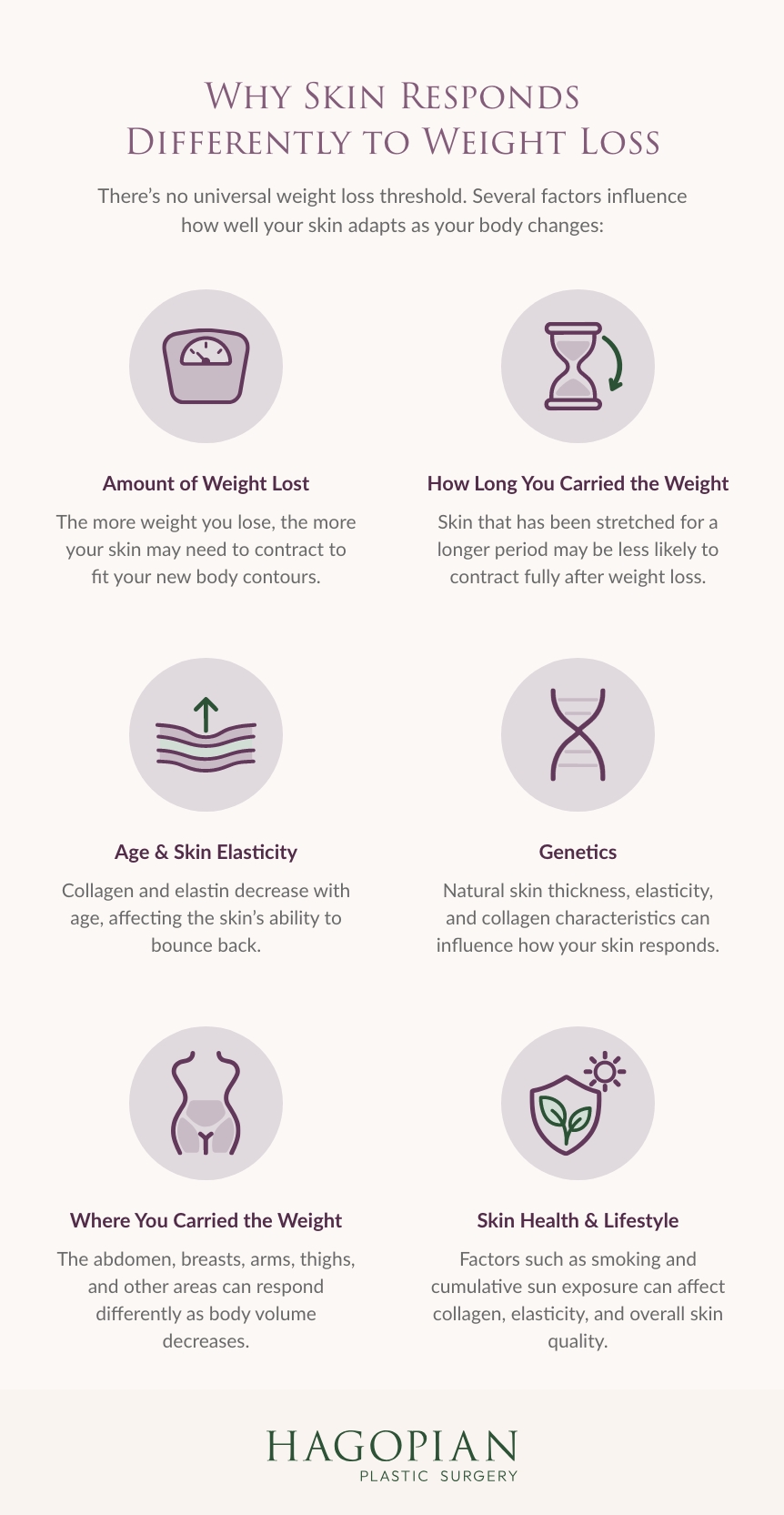
The amount of loose skin you develop, therefore, depends on the combined effects of your anatomy, skin characteristics, and weight history, not a specific number of pounds lost.
How Much Weight Can You Lose Without Loose Skin?
There is no maximum amount of weight you can lose without developing loose skin. In general, the more weight you lose and the more significantly your skin has been stretched, the greater the possibility that some excess skin will remain.
For example, someone who loses a relatively modest amount of weight and has good skin elasticity may see the skin gradually conform to the body’s smaller contours. After major weight loss, the skin has considerably farther to contract, and complete retraction becomes less likely.
How long you carried extra weight matters, too. Skin that has accommodated a larger body size for many years has undergone prolonged stretching. Age can compound these changes because the skin naturally produces less collagen and elastin over time.
These variables make a precise cutoff misleading. A certain number of pounds lost can’t predict whether you will have loose skin or how much you will have.
If I Lose Weight, Will I Have Loose Skin?
You may have some loose skin after losing weight, particularly following significant weight loss, but the amount and location are highly individual. Excess skin tends to be most noticeable in areas that experienced substantial expansion as your weight increased, such as:
- Abdomen and waist
- Breasts or chest
- Upper arms
- Inner and outer thighs
- Buttocks and lower body
- Face and neck
Where you carried your weight before losing it can influence which areas are most affected afterward. You may also have laxity in several areas but find that only one or two particularly bother you.
What Does Loose Skin After Weight Loss Look Like?
Before-and-after photos can show something a discussion of pounds and skin elasticity cannot: how excess skin may affect different areas of the body after significant weight loss and how body contouring surgery can reshape those areas.
Abdomen
WARNING:
This feature contains nudity. Please click OK to confirm you are at least 18 years of age and are not offended by such material.


Thighs


Upper Arms


Can You Prevent Loose Skin While Losing Weight?
You can’t guarantee that you will avoid loose skin during weight loss. Healthy nutrition, adequate hydration, resistance training, and good skin care can support your overall health and skin quality, but they cannot make significantly stretched skin contract completely.
Most importantly, the possibility of loose skin shouldn’t discourage you from pursuing weight loss that is appropriate for your health. Excess skin can be evaluated after your weight has stabilized, rather than being a reason to avoid making beneficial changes.
What Can You Do About Loose Skin After Weight Loss?
Your options for addressing loose skin depend on how much you have, where it is located, and whether it causes aesthetic or physical concerns. Mild skin laxity may not require treatment at all, while significant folds of excess skin can typically be removed only with surgery.
Post-weight loss body contouring isn’t a single operation. Instead, plastic surgery can be customized to address the areas of excess skin. Depending on your anatomy and goals, your plastic surgery options after weight loss may include:
- Tummy tuck: Removes excess abdominal skin and, when needed, tightens weakened or separated abdominal muscles.
- Arm lift: Removes loose skin from the upper arms to create a smoother contour.
- Thigh lift: Addresses excess skin affecting the thighs.
- Breast surgery: Reshapes and elevates sagging or deflated breasts with a breast lift; breast augmentation is considered when additional volume is desired.
- Upper body lift: Combines procedures to address excess skin and improve contours across multiple areas of the upper body, such as the arms, bra line, upper back, and chest.
- Lower body lift: Addresses excess skin and tissue in the lower torso, including the abdomen, hips, buttocks, and outer thighs.
Not everyone needs or wants multiple procedures. The right approach depends on where your concerns are concentrated, how much excess skin is present, your health, and what you hope to accomplish. A consultation with a board-certified plastic surgeon can help you understand which options are appropriate for your anatomy and goals.
When Should You Consider Plastic Surgery After Weight Loss?
Body contouring surgery is generally best considered once your weight is stable and you are healthy enough for surgery. Waiting until major weight changes are behind you allows me to evaluate your body contours more accurately and helps protect the results from substantial additional weight loss or gain.
Reaching a particular number on the scale isn’t the only consideration. I’ll evaluate your overall health, weight history, areas of excess skin, body proportions, and goals when determining whether you are a good candidate and which procedures may be appropriate.
If several areas need treatment, I often combine procedures when it is safe and appropriate. Combining procedures can allow you to address multiple concerns in a single surgical event and complete a single recovery period, rather than undergoing separate operations and recoveries. When the extent of surgery, recovery demands, or other safety considerations make combining procedures inadvisable, I may recommend staging your treatment plan over multiple operations.
Explore Your Options After Weight Loss
If you’ve worked hard to lose weight but are left with loose skin that keeps you from fully enjoying your new contours, body contouring surgery may help you take the next step. I invite you to call our office today at (404) 885-8542 or request a consultation using the online form.
Leave a Reply